|
The
story of the Superpan
Part
2
|
After
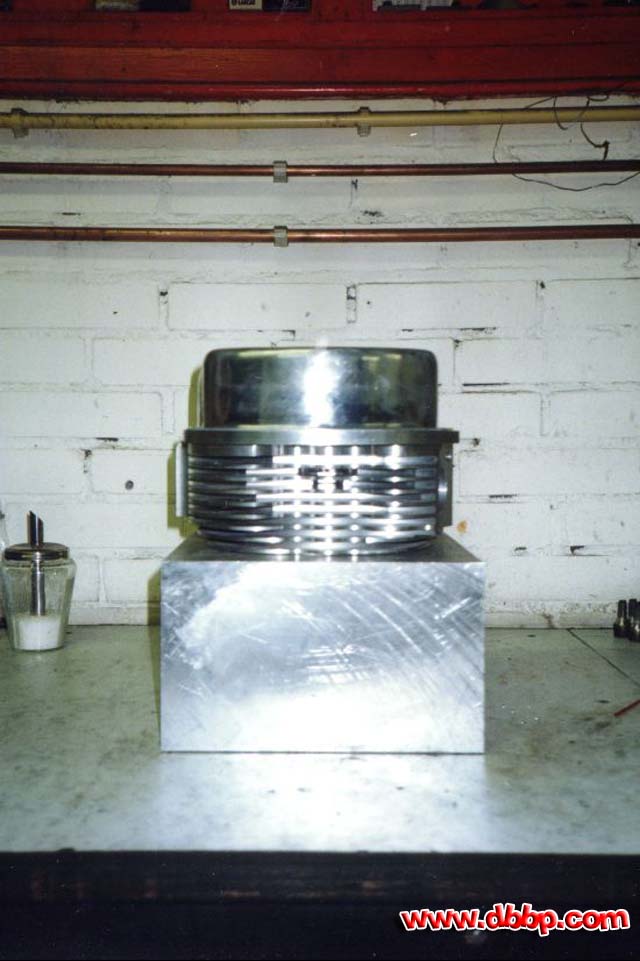
machining the front head..
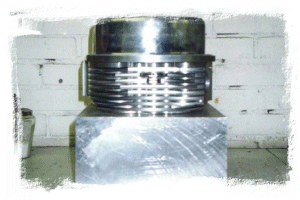
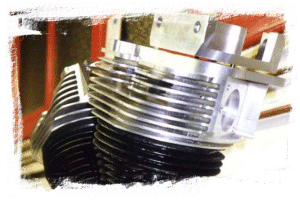
Ronny started with the rear head. This time, armed
with the experience gained machining the front head, he decided
to do one thing differently: the rear head was made with a separate
block containing the rockers.
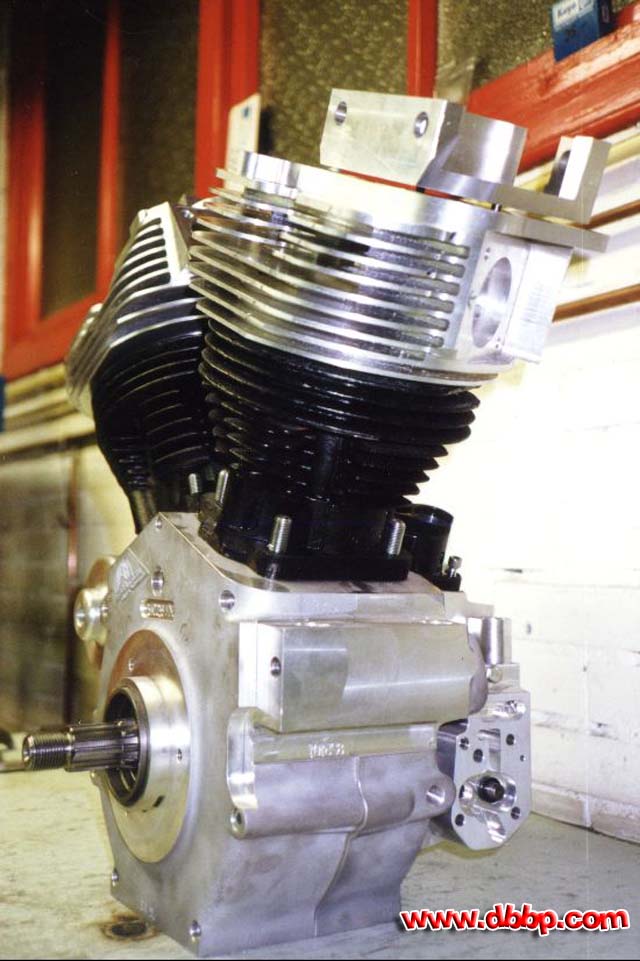
As you may have guessed by now, RB was not going to stick these
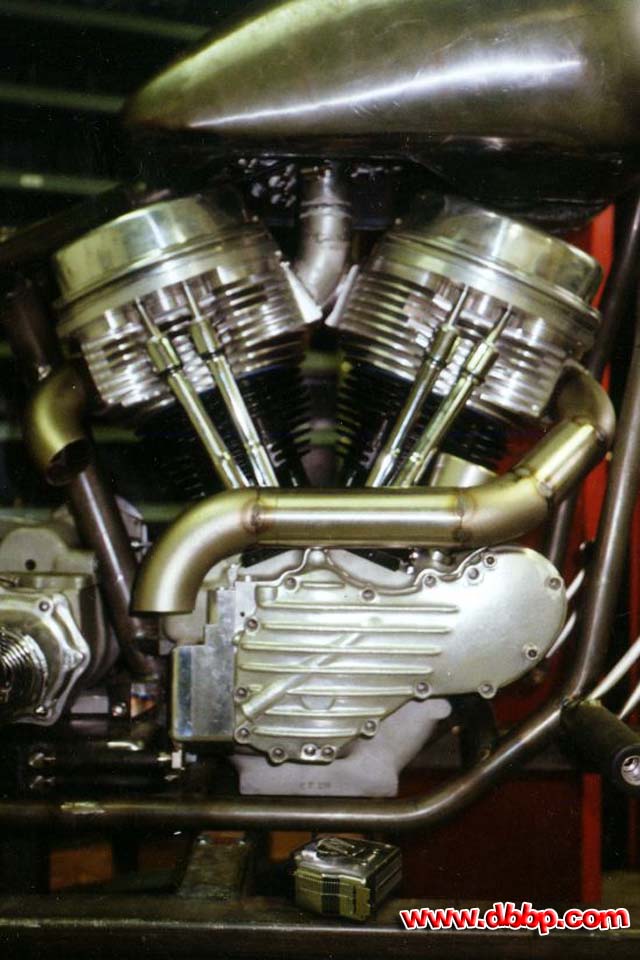
high-tech heads on a stock engine: RB started with an EVO crankshaft
in a set of Delcron generator crankcases.
|
 |
|
|
He added an Andrews EV27 cam and a set of EVO tappet blocks which
he had to modify to accept the panhead lifter angles. The cylinders
are 3 5/8" big-bore bringing the displacement to 88 cubic
inches, or 1442 cubic centimetres for us metric guys. The compression
ratio was calculated at about 10:1. For carburation he used two
41 mm flatslide Keihin downdraft carbs (from a Ducati) with separate
intake manifolds
|
|
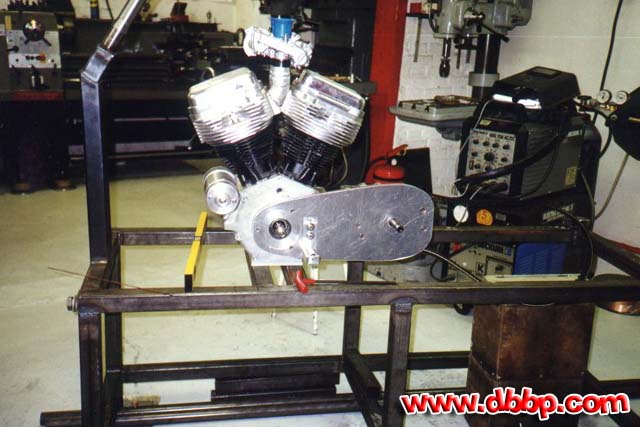
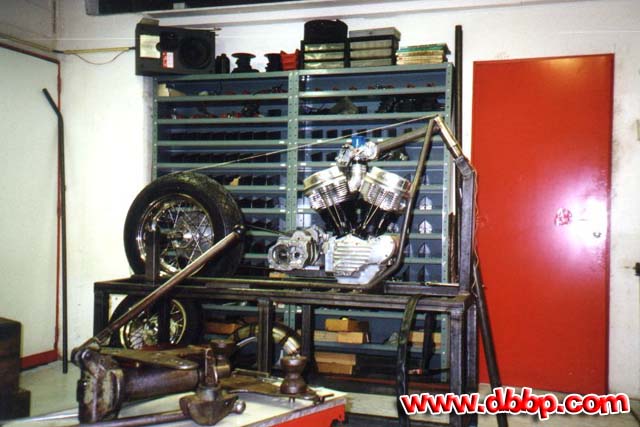
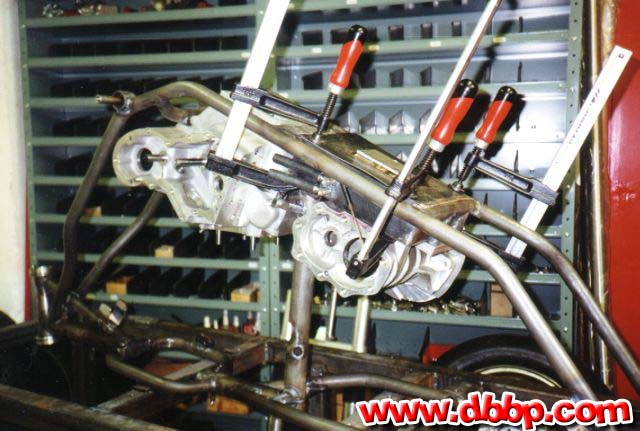
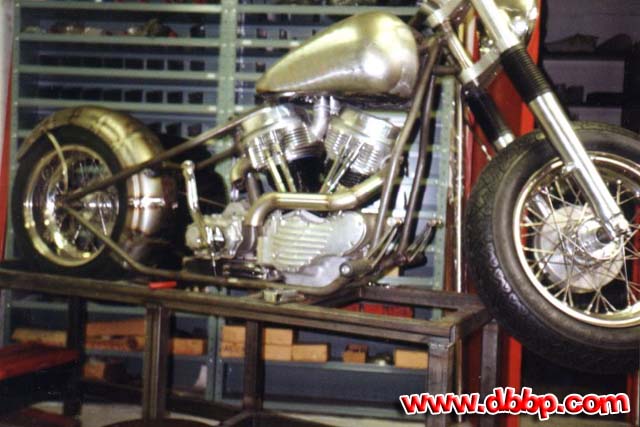
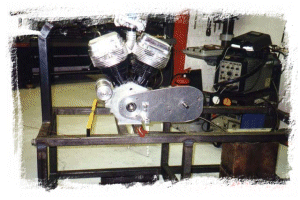
When the engine was finished, RB bolted it to a
homemade rear primary plate, together with a 4-speed gearbox.
RB had already decided to build his own frame, so he started by
constructing a welding jig (the tablelike construction used to
align and position the various components for welding) In the
photo on the right he has aligned and mounted his engine and gearbox
to the welding jig
|
 |
|
|
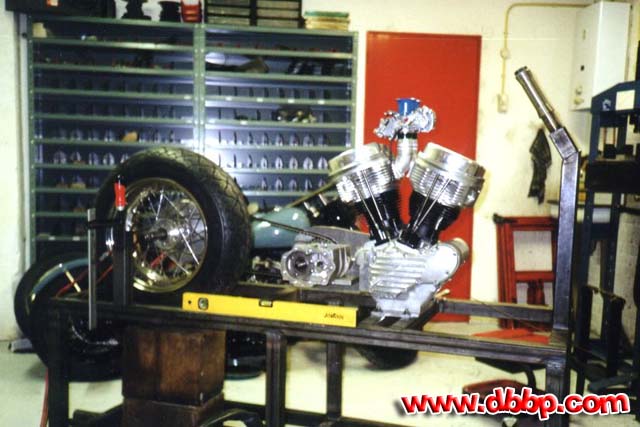
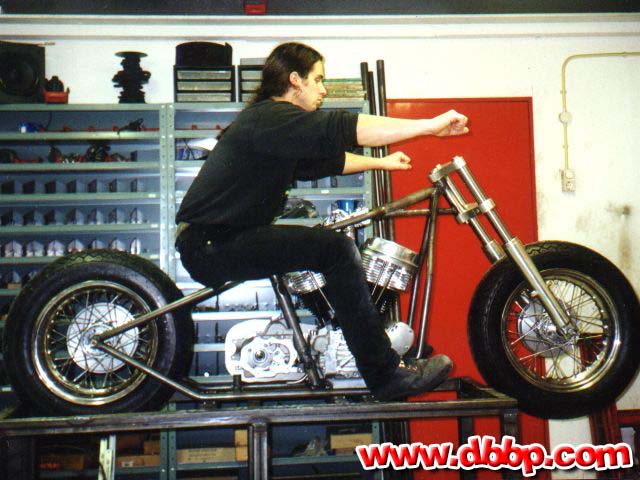
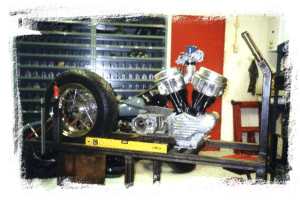
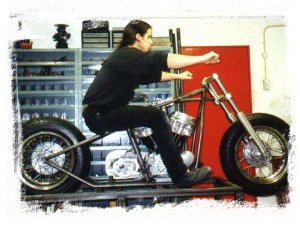
In the picture on the left you can see RB has positioned the rear
wheel. The rear hub is a homemade aluminum part (more about this
later), the rear drumbrake is also homemade and is built in to the
rear pulley of the secondary belt-drive. RB used a 170x15 rear tire
on a 6J rim, bringing the total width to 185 mm |
|
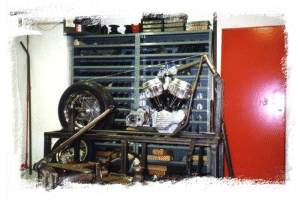
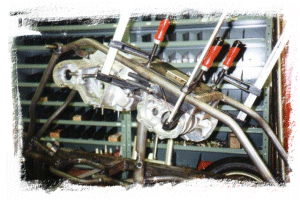
Using a pipe bender, RB fabricated the different
parts of the frame, making a complicated job even more complicated
by running the cables for the forward controls through the frame
and by letting the frame double as an oiltank. Most of the oil
goes in a compartment under the gearbox, the center pipe of the
frame is the filler tube.
|
 |
|
|
Why, you ask? Well I guess RB is a perfectionist and the
result of all this work is that there are no more than a few inches
of oilline on the whole bike and all cables and wires are very hard
to find also! Most bikebuilders will tell you that when building
a new bike, the bike usually looks best when all the main compo-
nents are in place, but all the cables, wires and other messy bits
have not been attached yet. |
|
This is the look that RB has managed to keep, in
his completed bike, pure and simple and very very clean.
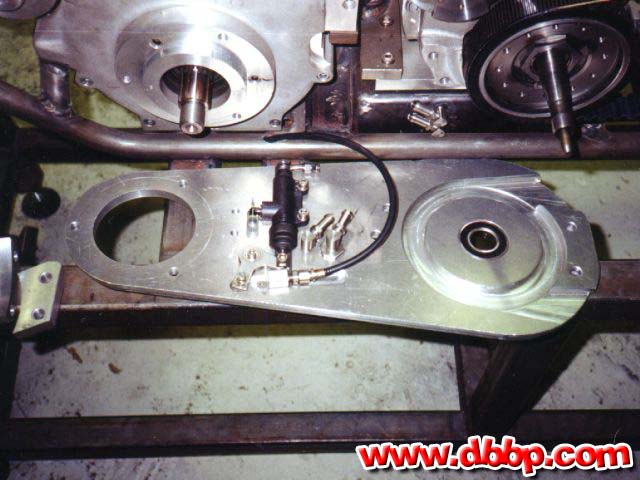
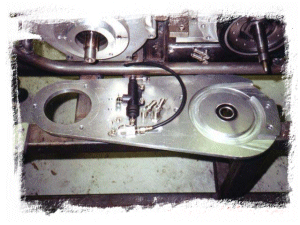
The inner primary plate, homemade ofcourse, serves
as the mounting point of the support bearing, oil filter, rear
brake caliper and rear brake fluid reservoir.
|
 |
|
|
Now I promised I would tell you a bit more about the wheels;
to save weight RB machined both his brakedrums and hubs
out of solid lumps of aluminum, beefing up the bearing areas so
the hubs would accept modern bearings. Then he drilled 40 holes
under the correct angle in each hub, and laced up his rims. Sounds
simple enough, eh?
|
|
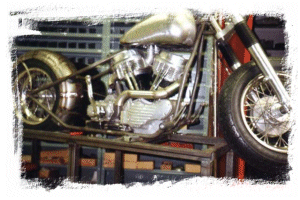
The fork consists of a set of homemade aluminum
triple trees, 2" overstock fork tubes and a set of 50's style
FL lower legs
The gastank was made by welding together a set of
6 gallon fatbobs, leaving a large opening in the bottom for the
two downdraft carbs, the rear fender was made to follow the radius
of the rear wheel exactly by cutting and welding and cutting and
welding etc.....
|
 |
|
|
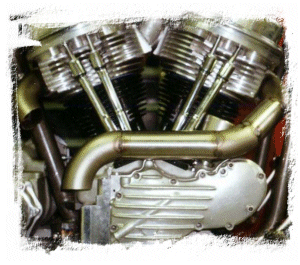
The 2 into 1 exhaust pipes were welded together using stainless
steel bends and pipe sections, ending in a Supertrapp muffler.
Next week: Starting the Superpan for the first time, the paintjob
and tons of details
|
NEXT
|